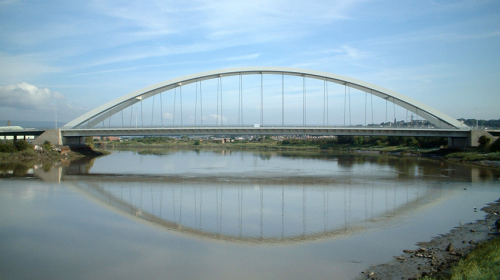
Arch bridges are one of the oldest types of bridges and have great natural strength. Instead of pushing straight down, the weight of an arch bridge is carried outward along the curve of the arch to the supports at each end. These supports, called the abutments, carry the load and keep the ends of the bridge from spreading out.

A beam or "girder" bridge is the simplest and most inexpensive kind of bridge. In its most basic form, a beam bridge consists of a horizontal beam that is supported at each end by piers. The weight of the beam pushes straight down on the piers.The beam itself must be strong so that it doesn't bend under its own weight and the added weight of crossing traffic. When a load pushes down on the beam, the beam's top edge is pushed together while the bottom edge is stretched .

Suspension bridges can span distances from 2,000 to 7,000 feet—far longer than any other kind of bridge. They also tend to be the most expensive to build. True to its name, a suspension bridge suspends the roadway from huge main cables, which extend from one end of the bridge to the other. These cables rest on top of high towers and are secured at each end by anchorages. The towers enable the main cables to be draped over long distances.
Most of the weight of the bridge is carried by the cables to the anchorages, which are em bedded in either solid rock or massive concrete blocks. Inside the anchorages, the cables are spread over a large area to evenly distribute the load and to prevent the cables from breaking free.

A cantilever bridge is like a springboard, with a beam (called the cantilever) projecting horizontally in space, and attached on one side. The pier to which it is attached has another beam in the opposite direction to counterbalance the weight of the cantilever. This supporting arm is called the anchor arm, as it is anchored to a solid support on its opposite end. Most cantilever bridges have two cantilevers.

No comments:
Post a Comment